A Message from Georgios Anagnostou
Director of the Modern Greek Program
The Ohio State University
Dear Friends of the Ohio Greek-American Community,
It is a pleasure to share with you once again the highlights of our faculty and students in 2025. The faculty continues building on the Program’s national and international reputation. This year, we had a robust presence in conversations about Greek language education in the United States, highlighting the importance of teaching Greek American material in the language classroom. We continue our outreach activities in Greek, Greek American, and Greek Australian media.
Student enrollments remain strong, and summer study in Greece is thriving. Notably, six students enrolled in the 2024 THYESPA study abroad program. Our students continue placing themselves in promising professional careers. Three students from our program continue to teach at the local Greek Orthodox community’s Greek language school. The Greek newspaper TO BHMA featured two life stories crafted by our students, “The Life of a Greek Recently in America: My Story” and “Growing Up Greek in America.”
In this issue, you will also read essays about the power of poetry, the traces of an immigrant past in a small town in Utah, the local community magazine Ethos, the activities of the Laboratory for the Study of the Greek Language, along with news about our students’ experiences in summer study abroad in Athens and our graduating seniors.
Sincerely,

Georgios Anagnostou
The Miltiadis Marinakis Professor of Modern Greek Language and Culture
The Greek Lab at Ohio State — 2025 Activities
Brian D. Joseph
This past year, 2025, was an eventful period for the Laboratory for the Study of the Greek Language. As proud founder and director of the Greek Lab, as we informally call it, I am pleased to enumerate the goings-on at the Lab.
Perhaps the biggest news is that the planned publication series through the OSU Libraries’ Knowledge Bank has now been launched. The series is known as p.GLOS, standing for Publications of the Greek Lab at Ohio State, and the “GLOS” acronym is meant to summon up the Greek word γλώσσα meaning ‘language; tongue.’ The inaugural items in p.GLOS are the three volumes written by nonagenarian John Kellis, a native of Mestá on the island of Chios and a prominent Ohio businessman. The three volumes are Mestá, People of Mestá, and Tales of Mestá, and they chronicle the history, culture, and language features of this village on Chios. These volumes can be accessed on the web at https://kb.osu.edu/items/7fcebe31-11fe-4902-b319-3825a73bb316/full. Other volumes in the p.GLOS series will be added in the coming months.
A second exciting development involving the Greek Lab in 2025 is that Dr. Rexhina Ndoci (Ph.D., 2024), who worked on Greek projects in the Lab while a graduate student in Linguistics, has taken a job as a lecturer at the University of California, Berkeley, teaching Modern Greek language and related classes. We wish her well and are pleased that her success as a graduate student working on Greek-related topics—her dissertation was on the linguistic dimensions to the discrimination suffered by Albanian immigrants to Greece in the past few decades — has translated into this further professional success.
The year 2025 also saw the continuation, with support from the Greek Lab, of a week-long summer seminar in Greece, the International Seminar on Modern Greek for Classicists, organized by Director Joseph working together with his colleague from the University of Ljubljana, Slovenia, Professor Jerneja Kavčič (OSU Modern Greek professor Dr. Christopher Brown, also the Associate Director of the Greek Lab, was involved in the planning of the seminar and its curriculum in the days before the Covid pandemic). This year’s seminar was held in Nafplio (previous ones had been held in Athens), under the auspices of the Harvard University Center for Hellenic Studies located there. We had 20 students from some half dozen different countries, including an OSU Classics Ph.D. student, Rachel Gastrich, whose attendance was made possible by a grant from the Greek Lab, and who had this to say about her experience, by way of endorsing the seminar: “I really enjoyed last year’s seminar, and I would love to attend again as I am planning on taking Modern Greek this coming fall.”
On the research front, not only has Director Joseph continued his work on various aspects of Greek linguistics, but his co-authored (with Victor Friedman of the University of Chicago) book The Balkan Languages (Cambridge University Press) came out in 2025 after 25 years of the authors working on it. Although it treats all the Balkan languages, there is a lot of attention to the Balkan side of the Greek language, so it clearly contributes to the study of the Greek language. The book has been brought out as a fully open access work and thus a totally free download —the text and indexes can be downloaded from https://www.cambridge.org/core/books/balkan-languages/DF1897CA3A024BFF3AB73392CD28822E and the bibliography, a color map and a correction sheet can be downloaded, also as an open access work, from https://www.cambridge.org/gb/universitypress/subjects/languages-linguistics/other-languages-and-linguistics/balkan-languages?format=HB#resources.
Throughout 2025, various lab-connected students were working on Greek-related research: Lindon Dedvukaj has been studying and writing on Albanian etymology with consequences for understanding contact between Albanian and Greek; Clayton Marr has worked on Greek loanword evidence for understanding Albanian historical phonology; and Shinnakrit Tangsiriwattanakul has been working on mergers of form within Indo-European noun morphology, with considerable attention to relevant Ancient Greek evidence.
The Greek Lab also supported a December visit and two lectures from Dr. Ugo Mondini (Oxford University / Dumbarton Oaks) on Byzantine Greek topics: “From Byzantium to the Ottoman Classroom: Schoolbooks and Greek Language Education” and “Language, Metre, and Poetry in the Greek Middle Ages. The Case of Ioannes Mauropous.”
Thus all-in-all it was an active and stimulating year for the Greek Lab, with more in store for 2026!
You Always Come Home to Poetry
Gregory Jusdanis
While I don’t remember his name, I do recall his story vividly. I had come to the Argentinian capital of Buenos Aires in the spring of 2014 to hold seminars on the Greek poet, Constantine Cavafy (1863-1933). At the start of the class, I was full of apprehension since it was going to be in Spanish. How was I going to do? When I open my mouth, would Spanish words come out? Would my students be able to understand my accent?
Standing nervously in front of the desk, I counted the students as they entered. They numbered about 30. Imagine thirty people signing up for a seminar on a Greek poet, I said to myself. As I got to know them over the month, I came to see that they represented a mixed group: professors from the university, retirees, novelists, poets, graduate and undergraduate students. Because of their diverse backgrounds and their commitment to Cavafy, they made the class one of the most intense and fascinating teaching experiences of my life.
At the end of the first seminar, relieved to have been able to speak Spanish for three hours, I was folding together my papers when one of the graduate students approached me. He was from Caracas, Venezuela, and had come to Buenos Aires to do an MA in Engineering. “Are you of Greek descent?” I asked. “No,” was his quick response. “Why are you taking my class?” I asked in astonishment. And then he told me his story.
Before he set out from Caracas in the northern tip of Latin America to Buenos Aires by bus, an epic journey that took him about two weeks, his father had given him a copy of Cavafy’s poem, “Ithaca.” While I understood the significance of this gesture, I was amazed that a Venezuelan father had offered a Spanish translation of Greek poem to his departing son. “It’s the power of poetry,” his father had told him. “You always come home.”
“Ithaca” is one of the most popular of Cavafy’s poems. Sean Connery’s dramatic reading of the text set to the music by the composer, Vangelis, has over 1.1 million views on YouTube. It is celebrated around the world because it states that life is a journey and the journey is life. “As you set out for Ithaca pray that the way be long, full of exploration, full of learning,” Cavafy says. And he reminds us that we should take our time since it’s the only odyssey we will have. “Ithaca” is loved by millions because it offers an inspirational message to us all about our own personal journeys. He speaks to us whether we live in Caracas, Buenos Aires, Columbus, or Athens.
I was touched and encouraged to discover from the Venezuelan student that Cavafy and poetry generally can still have broad appeal in a time when the relevance of literature is put into doubt. And it is a message that I have picked up from audiences this year as I have traveled to read from the biography of Cavafy, which I co-wrote with my colleague, Peter Jeffreys. In Canada, the United States, and Europe, people have come to hear about Cavafy’s story.
In one respect, this is understandable. A biography, insofar as it tells a life story, appeals to broader audiences that find it easier to grasp a narrative as opposed to a scholarly study, say, on Cavafy’s use of irony. At the same time, it can’t be denied that people around the world find Cavafy fascinating and relevant. He is the one modern Greek author who has broken away from the gravity of Greek literature to attain a place in the pantheon of world literature.
I saw the repeatedly in my readings and lectures. In Amsterdam, for instance, more than 100 people had come to the presentation. In Phoenix, Arizona, I was astonished to see about 10 undergraduate students buying copies of the book.
During this year, I have heard many stories like the one related to me by the Venezuelan student in Buenos Aires—from people unrelated to Greece and literary study who nevertheless felt that Cavafy spoke to them. In our anxious epoch, when we are threated to irrelevance by AI and to extinction by climate change, it is heart-warming to know that people still find a home in poetry.
A New Community Project: Editing Ethos
Evangelia Philipiddis
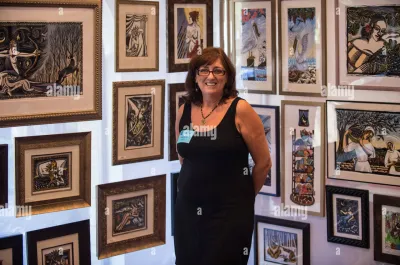
I spent 22 years working with some of the best journalists in the Midwest while I was at the Columbus Dispatch. Now I find myself in a position to put some of that knowledge to work as editor of Hellenic Ethos. As English is my second language I find it a daunting task, at times, to write poignant articles as well as edit other people’s stories while staying true to their original voice.
I can only hope that, working with such talented reporters and editors for so many years, I have learned a thing or two.
When I took over as editor for Ethos, I took on a huge responsibility of making sure that, as they say in the newsroom, all the I’s were dotted, and T’s were crossed. I also had to decide which direction I wanted the magazine to go and put my own stamp on it. So, I did the most logical thing: I looked up the definition of “ethos,” which, according to Webster, is “the characteristic spirit of a culture or community defined by its beliefs and traditions.” I also took into account feedback from the greater Greek community I am part of. It’s rich and proud in culture, religion, traditions, and ties to Greek history. I reimagined the magazine as a reflection of the Columbus Hellenic community and our parish.
For one, I changed the name from Greek Ethos to Hellenic Ethos because the word Greek is not applicable. We are also a large community made up of several generations. I felt that we needed to preserve the wisdom of our aging population, which serves to guide future generations and encourage our youth to embrace their traditions. It is important to showcase the artistic, musical, and literary talents of those with whom we share our culture and our community. Some of our new converts, though not Hellenic by birth, are in their souls. I believe that through the inclusion of our traditions, foods, arts, and history in the magazine, those not of Hellenic descent can explore and embrace the culture.
I am fortunate not only in my past associations but also in the assistance provided by the professors and students of OSU’s Modern Greek Studies and Classics Departments, and I encourage faculty and students to reach out and propose more articles based on their individual expertise and interests.
Traces of the Greek Immigrant Past in the Intermountain West
Yiorgos Anagnostou
Across the intermountain region, in the states of Utah, Colorado, and New Mexico, early 20th-century immigrant Greek America still features in public spaces beyond community settings. A visitor could piece together a collage of its traces interspersed across American museums, archives, paintings, cemeteries, and statues of immigrant labor leaders. A long-gone past meanders its way into our present through material objects, images, oral testimonies, and printed words.
Early one morning in Fall 2026, while visiting Salt Lake City, a friend of mine and I made a point of exploring Magna, only a 25-minute drive away. It was only recently that the town registered in my mental map of immigrant Greek America in the region. My personal imaginary includes Helper, Utah, the place where historian Helen Papanikolas was raised; the Hellenic Cultural Museum in Salt Lake City; the site of the Ludlow massacre, near Trinidad, Colorado; and the cemetery in Price where the remnants of the Greek miners killed in the Castle Gate mine explosion in 1914 were laid to rest. It’s a geography dotted with visible and invisible remains.
It was a family story that added Magna to my personal geography of the region. Reminiscing about his immigrant ancestors, historian Zeese Papanikolas speaks about his newly married grandmother, freshly arrived from Greece, moving into her new home in town. The move came with an arrangement not uncommon among immigrant money-saving adaptations. It was a home where “she settled down to life not only with her husband, but two boarders.” The home “still existed when cousins who lived in Magna as children saw it, nothing more than a glorified toolshed in the backyard of another house.” It was this passage, imprinted on me, that propelled my visit.
According to historian Katie Calton, in “Kennecott's Greek History,” (https://www.intermountainhistories.org/items/show/155), Magna was a robust mining town early in the 20th century, known for its closeness to Bingham Canyon Copper Mine—known as Kennecott Copper Mine among locals—the “largest human-made excavation and the deepest open-pit mine on Earth.” It was a magnet for immigrants. “In 1904 there were 2,000 [Greek] names on the payroll at Bingham Canyon,” which increased to 3,239 by 1912, making up 37.4 percent of the labor force.” Local Greek Americans still remember a grandfather or great-grandfather working in the industry.
Historians in the region reconstruct fragments of early immigrant life in the town. “Enclaves of Greek families,” Katie Calton writes, “formed in Magna, which was referred to as ‘Little Greece.’ … The Ku Klux Klan’s branch in Salt Lake County was active around the mining towns that attracted Eastern European immigrants, and some Greek immigrants in Magna tell of the KKK’s white cross burning at the end of the street.” I wonder whether Zeese Papanikolas’s grandmother experienced such an incident. If so, how did she feel?
The early 20th-century immigrant experience in the intermountain West moves me deeply, even haunts me, inexplicably. It was a period when millions of immigrants from rural Southeastern Europe entered the United States, encountering the industrial modernity of America. It set in motion an array of dramatic transitions. From farm work to industrial labor. From embeddedness in family and community to alienating situations. It involved negotiating a new language and coping with new rules for conducting oneself. Exploitation and virulent nativism made everydayness a harsh reality, leading to new political behaviors—joining labor unions. The scale of these transformations dwarfs me.
Regional memory of this past still exists, yet it is fading. I was curious about how its echoes are expressed in Magna. Who does the remembering? Our itinerary included a visit to the must-see Magna Ethnic and Mining Museum, a stroll in the town, and a ride to the Kennecott Copper Mine, which, to our chagrin, was closed to visitors.
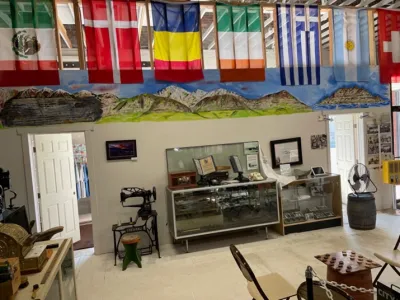
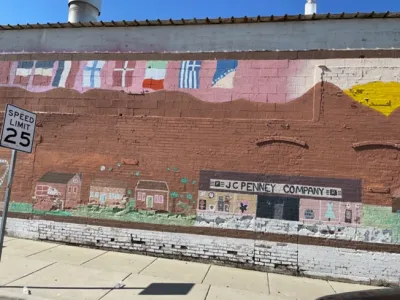
The museum honors the immigrants for their contributions to the country, a conventional tribute; their labor is recognized as a force for building the nation’s economic might. Prominently displayed are more than twenty national flags corresponding with the origins of the immigrants. This visual narrative also dominates the town’s square in the form of a mural. Civic institutions inscribe the immigrant past in the identity of the place.
In the museum’s interior, under the rags-to-riches iconography, we encounter scattered fragments of the past: family photographs, autobiographical snippets, genealogical trees, business brochures, vignettes of acculturation, and stories of economic mobility.
Stepping outside, strolling along the street, beyond the celebratory mural, the urban landscape testifies to the disappearing immigrant presence. One business announcing ethnicity via the name of its owner is abandoned. Another one, also marked ethnically, appears to be in a state of neglect if not unoccupied. The few traces of the past are crumpling in front of our eyes.
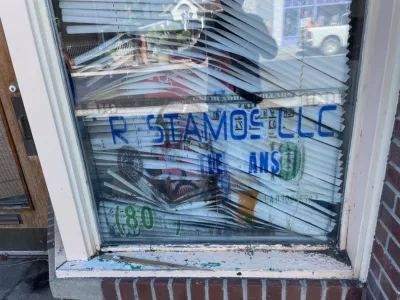
I venture into a solitary walk to observe and take all this in. The initial knot in the stomach tightens. Witnessing the ruins of the immigrant presence, I contemplate the enormity of the historical weight of its past. Vast labor, losses, aspirations, dreams pursued, achieved or unfulfilled, lives violently interrupted. What does one do with a past dissipated to a shadow of itself?
We do have a valuable historical record of the early twentieth century immigrant Greek America. In the intermountain region, an image, a canyon, a town, a sealed mine, a list of names in a historical marker, a series of graves, a historical figure come alive through the labor of historians who, in the 1960s, 1970s, and 1980s, turned family lore and eyewitness accounts of immigrant life into projects documenting it.
But another layer of absences presses on me, further unsettling things. With small-scale yet vital exceptions, no generation of researchers has shown an interest in the present of Greek America’s intermountain West.
If the past hangs in public ruins and museum displays, the research community has abandoned its future. A historical gap, unbridgeable, elusive. A gap that makes me gasp.
Modern Greek Faculty in the News
Gregory Jusdanis (along with Peter Jeffreys) published C. P. Cavafy. A New Biography in August of 2025 with Farrar Strauss & Giroux. It appeared in the UK with Simon & Schuster and in Greece with Metaichmio, where it became a bestseller. Widely reviewed in the American, British, and Greek press, the book won the Ouranis Prize for Biography offered by the Academy of Athens, and was longlisted for the National Book Critics Circle Award and shortlisted for the Runciman Prize.
Yiorgos Anagnostou gave talks at Boston University and the Archidoisen Center in Queens, New York. He published numerous essays, articles, and book chapters while continuing to edit the online, open access journal Ergon: Greek/American & Diaspora Arts and Letters, a labor of love.
Christopher Brown published the essay “Reflections on Greek in Ohio” in the Greek newspaper TOVHMA. https://www.tovima.com/opin.../reflections-on-greek-in-ohio/
Modern Greek Program Activities
The Thirty-Fifth Thomas E. and Anna P. Leontis Memorial Lecture in Modern Greek Studies (2025)
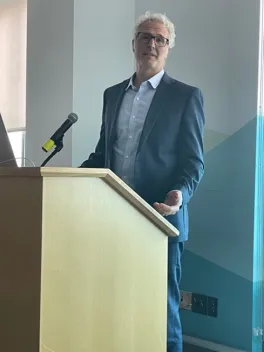
Our speaker was Christopher Witmore, Professor in Archaeology and Classics, Texas Tech University, whose talk drew from his work on the island of Samothrace, documenting Greek agrarian practices in the ancient and most recent past. What can we learn from the past, he invited the audience to reflect, as we try to serve as the stewards of the environment today?
Beyond the plate: Ethnographic encounters in London’s Greek and Italian foodscapes (2025)
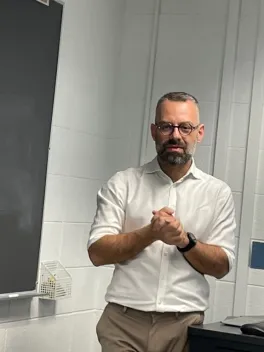
The Laboratory for the Study of the Greek Language and the OSU Modern Greek Program presented a lecture by Dr. Petros Katsareas, Reader in Multilingualism and Language Contact, University of Westminster. His talk, “Beyond the plate: Ethnographic encounters in London’s Greek and Italian foodscapes,” explored “the intersections of food, language, and migration by examining how Greek and Italian hospitality professionals in London use food talk to position themselves within the city’s evolving food scene.”
Testimonials of Students in the Summer Study Abroad Program in Greece (THYESPA)
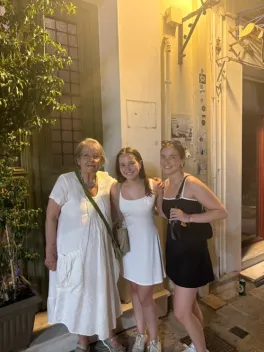
Alexandra Metsika
This past summer, I had the incredible opportunity to participate in the modern Greek study abroad program, THYESPA. My peers in Greek classes had highly recommended it, not only for its strengths in speaking skills, but also for the confidence it instills in using the language. Over the six-week program, we attended classes each day from 9 a.m. to 12:30 p.m., with weekly field trips to historical Greek sites. Our classes included students from across Europe; it was heartwarming to see the language of my family being embraced by so many people around the world. In class, we were challenged with Greek’s difficult grammar, but enjoyed learning through songs, role-playing, and presentations. Our teachers were spectacular, giving us personal tours of historical sites, entirely in Greek. We were encouraged to ask questions in Greek, pushing us to immerse ourselves fully in the language.
I was especially fortunate to experience THYESPA with my younger sister, Victoria. On weekends, we explored different parts of Greece, including Santorini, Volos, the village where our mom was born, and many other islands. Everywhere we went, we were welcomed with incredible hospitality. When locals learned we were Greek Americans, they often shared special dishes of their island, stories, and even generous discounts at their businesses. We were also able to connect with many of our family members by visiting their homes, sharing meals, and listening to their stories. THYESPA was a life-changing experience. It not only strengthened my Greek speaking skills but also deepened my connection to my heritage. I am so grateful to have had this opportunity, something that would not have been possible without the support of Kurio Brown and The Ohio State University.
Victoria A. Metsika
This summer at THYESPA was truly unforgettable. I was able to experience it alongside my sister, which made every moment even more meaningful. Each weekend, we traveled to a different island, discovering the unique beauty and culture of Greece. During the week, our class went on excursions together, exploring new places and learning side by side. Our group included students from Russia, Georgia, Poland, Spain, and Turkey, and by the end of the program, I had made friends from all over the world. Between the adventures, the people, and the shared memories, it was a summer I’ll always treasure.
Mason Stams
The THYESPA program experience was one of the best summers I have ever had. The program allowed me to make tremendous strides in my Modern Greek proficiency through daily classes at the University of Athens. However, I believe I learned just as much, if not more, by going to the local cafés, riding in taxis, and being completely immersed in the language. The program also introduced me to so many different people from all over the world, from Argentina, Brazil, Latvia, Mexico, India, just to name a few. When I was not in the classroom, I visited the islands of Zakynthos, Kefalonia, Ios, as well as the nearby countries of Albania and Montenegro. Apart from the food, views, and wine, I would say my favorite part was my teachers and classmates. The teachers genuinely cared about our learning experience and were very passionate about their work, and my classmates were awesome to hang out with outside of class. I even keep in touch with a handful of them to this day. I would highly recommend the THYESPA program to anyone considering it. It is truly a one-of-a-kind experience.
Jeffrey Warner
I spent my summer in Greece for the THYESPA program. My girlfriend came with me and worked remotely. We went on many excursions around Greece and in other countries, but also thoroughly explored Athens. On the first weekend we arrived, we did a day trip to Vouliagmeni. We ate tylikto gyros on the beach and walked to an old monastery, Agios Nikolaos. It was very interesting because it was covered in seashells and colorful tiles. It was very beautiful next to the water. It was about a 2-mile walk from the beach we were at, but it was worth it. Then, we walked to the lake nearby, where we ate dinner and drank while the sun began to come down.
Graduating Seniors (May 2026)
Modern Greek Major:
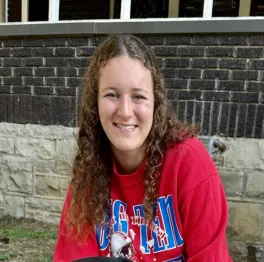
Elena Lioudis from Cleveland will graduate in May 2026 with degrees in microbiology and Modern Greek. She is a member of Sigma Epsilon Phi Greek fraternity, Buckeye Blood Club, and the honors program at Ohio State. Elena spent the summer of 2024 studying in Athens, Greece through the THYESPA program and plans to spend a year working in Cleveland while applying to medical school.
Modern Greek Minors:

Vasiliki (Leah) Nicoloulias, from Columbus, Ohio, graduated in December 2025 with a Bachelor of Science in Environment and Natural Resources specializing in Business and Sustainability, and a minor in Modern Greek. During her undergraduate years, she was an active member of Sigma Epsilon Phi and spent the summer of 2024 studying abroad in Greece through the THYESPA program. She aspires to help companies strengthen their sustainability practices, implement responsible business strategies, and advance long-term environmental goals. She also hopes to continue deepening her connection to her culture and furthering her Modern Greek language skills.
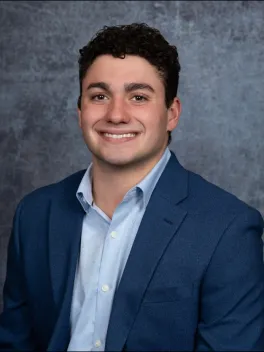
My name is Dino Gesouras and I'm from Columbus, Ohio. I will be graduating in May 2026 with a major in Strategic Communication and a minor in Modern Greek. During my undergrad, I was active in the Sigma Epsilon Phi fratority and intermural athletics. I will be working at CrossCountry Mortgage as a Marketing Analyst in August.
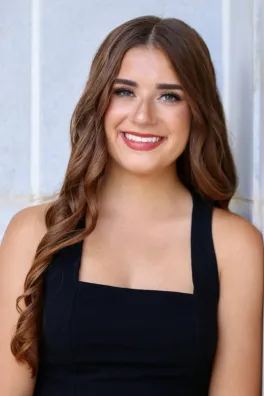
Sophia Sdregas from Campbell, Ohio is graduating in May 2026 with a major in Philosophy, Politics, and Economics and minors in Modern Greek and History. She is involved in Women in Law, Sigma Epsilon Phi Greek fraternity, Phi Alpha Delta prelaw fraternity, and Her Campus Ohio State. Sophia will be attending Ohio State University Moritz College of Law in the fall.
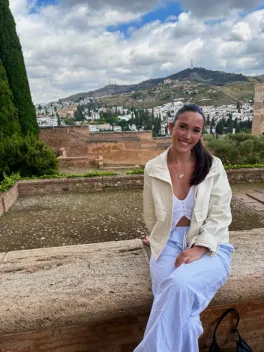
Ellie Nicoloulias from Columbus, Ohio is graduating in May 2026 with a major in Health Sciences and minors in Modern Greek and Business. She was an active member in the Sigma Epsilon Phi Greek fraternity. She also served as an executive member of Clear & Glowing, Ohio State’s skincare club. Ellie spent the summer of 2024 studying in the THYESPA program in Athens, Greece contributing to her Greek studies.
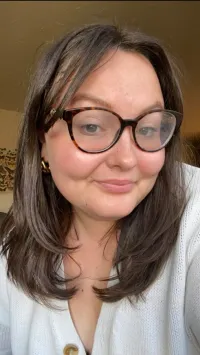
Katerina Alden from Cleveland Heights, Ohio, is graduating in May of 2026 with a Bachelor of Arts in Sociology and a minor in Modern Greek. Throughout her time at Ohio State Katerina has been involved in Sigma Epsilon Phi Greek Orthodox Fraternity, Scarlet and Grace Notes A Cappella, and the Ohio Student Association. She has also worked as a teacher at the Annunciation Columbus Greek Language School since 2023. Upon graduating, Katerina plans to take a gap year and serve in the Orthodox Volunteer Corps before going back to school to earn a master's in social work.
We would like to commemorate in this issue two special students who have contributed enormously to the Modern Greek Program in recent years.
In April 2026 Trevor Lee defended his PhD dissertation in Classics, “The Best and Most Serious People: Meritocratic Discourse in Late Antiquity.” Over the last five years Trevor has made enormous progress in Modern Greek; in his third semester he produced a remarkable video on the history of contacts between Greece and China which can be viewed here: https://go.osu.edu/china

I started taking Modern Greek classes in 2022 with very little knowledge of Greece beyond ancient history, but I instantly discovered just how much depth and complexity there is to the Greek language and Greece today (after all, I kept taking a Modern Greek class every semester since). While learning the language was certainly a fun process for me, I think my favorite part of the program at OSU is the wonderful sense of community between the instructors and students who all taught me so much about Greek culture as a living and authentic entity. Even though I’m not from Ohio (or Greek), I felt immediately welcomed in by everyone and always enjoyed hearing daily stories about entertaining individuals in the local Greek American community, words of wisdom from someone’s παππούς or γιαγιά, or a summer visit to someone's native village in Greece.
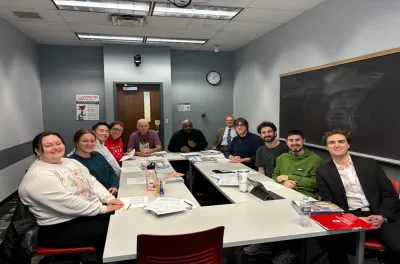
In May 2023, Romel Portis earned a B.A. in Modern Greek Studies. Returning to the Modern Greek Program after many years, Romel has developed a strong command of the Greek language, in addition to his command of Japanese, Chinese, and his current advanced studies in Korean. Over the last decade Romel has been a major contributor to the Modern Greek Program, through the many translations, vocabulary aids, and other resources he has compiled to help our students through all three volumes of the Greek textbooks ELLINIKA (Moschonas et al.). These important resources can be found on the website https://u.osu.edu/ellinika/ Romel is pictured above with fellow students in Modern Greek 5010, our most advanced Greek language class.